Freemasonry in the Northwoods
A brotherhood withers
Masonry
Simply mentioning it can send a comment section or conversation down a rabbit hole of conspiracy theories, foul accusations, and rumors of dark secrets. The public has a boundless imagination when it comes to Masonry, or Freemasonry as it's often called, and the group's reclusiveness doesn't do much to help its reputation. While I certainly enjoy a good conspiracy theory from time to time, I'm not one to believe fantastic claims without hard facts to back them. I like to deal in what I can know to be true, and here is my rough understanding of the history, and nature, of Masonry:
- In the Middle Ages, masons, actual stone working masons, had guilds and associations in which they regulated their business and made decisions. These were not open to the public.
- Freemasonry, the highly ritualized, esoteric masonry we know today, came in to its own in the seventeenth and eighteenth centuries (16/1700's). It grew out of the original work-oriented masonry guilds and was especially popular in France and England. This was a time of great upheaval in Europe and two ideas began to surface in those countries; that a layman could legitimately revolt against the church (the English Reformation and French Religious Wars), and that a subject could legitimately revolt against a king (see the English Civil War). These ideas were inherently intertwined as the monarch was seen as ruling on behalf of, and at the pleasure of God, who's will was interpreted and expressed through the Church. If you discredit the monarch you discredit the Church and vice versa.
- These ideas were revolutionary and eventually led to the Enlightenment, an era of philosophy that championed the individual and his rights. They were controversial and it wasn't always safe to discuss them in public. Their proponents found a safe haven in the secrecy of the old masonic guilds and the popularity of the ideas led to the groups' growth.
- A melding of the original secrets and rituals of actual masons and the ideas of the new, philosophical masons occurred, creating modern Masonry.
- Masons, and the ideas popularized in their lodges, went on to play pivotal roles in the French and American Revolutions. Most of those ideas are now popularly accepted in our culture and their roots in Masonry are obscured, partly because they weren't wholly Masonic ideas and were concepts individual Masons brought in to lodges from elsewhere.
- Masonry, brought from Great Britain, spread rapidly throughout the United States and was very popular. Many political and business leaders in our nation's history have also been masons.
While they started and still style themselves as secret societies that's really no longer true. They're out in the public and members don't hide their identities. Today, they're more of a social club with secrets than they are a "secret" society.
Despite their more recent openness, those secrets provide the foundation for the public's distrust of Masonry. Rumors abound about how they, in league with the Illuminati (a Bavarian Enlightenment era secret society similar to Masonry that was suppressed by the government), secretly control the world. That they're working with Jesuits to create a one world government (laughable considering the Church's position on Masonry), or that they're part of an unholy alliance with Jews and communists to undermine and ultimately overthrow Christendom (an idea popularized by the Nazi and Falange parties). Masons have fed in to this secrecy/suspicion cycle by claiming unbroken descent from the Knights Templar, or the even more remote biblical builders of Solomon's Temple.
They are, in my opinion, a fraternity with some very goofy, and highly symbolic rituals, and very tenuous claims to anything else. Rituals and secrets bind people together. They're great if you want to excite prospective members and keep current members captivated and coming back, so Masonry has a lot of them. If you want to start and popularize your own group take some notes on that from Masonry, Joseph Smith certainly did.
While I am positive that Masons have, and probably still do, occasionally extend privileges to fellow members in contexts, outside of the lodge, where that behavior is inappropriate, I don't imagine them hiding behind every tree, rock, and momentous moment in my life. That isn't realistic or healthy. What's probably more common is that Masonry serves, or rather served, as a social networking group, like LinkdIn or how many people treat churches or sports leagues. People enjoy each other's company, make friends, and then those relationships go on to express themselves in business, politics, or wherever. Almost every group works like that and Masonry isn't special in that regard.
So that's a very quick rundown of Masonry but what about Masonry in the Northwoods?
The Grand Lodge of Wisconsin, the governing body of Masonry in the State, whether on purpose or by accident, released and still hosts the 2021 Proceedings of the Grand Lodge on its website. It's over 200 pages long and pretty boring but there are some hidden nuggets of interesting info to be had if one looks hard enough.
The report paints a picture of an organization in decline with Northern Wisconsin having lost more than half of its groups of Masons in the last half century. The Northwoods was once home to over 50 lodges but just 26 are still in operation. That decline began in the 1980s, was steepest in the 90s, and continues to the present day. Almost all of the closed lodges were merged and consolidated with nearby groups.
Northwoods Freemasony Lodges
Active
Bayfield
Bloomer
Chetek
Chippewa Falls
Crandon
Crivitz
Eagle River
Florence
Hayward
Iron River (2 groups)
Ladysmith
Marinette
Mercer
Merrill (2 groups)
Minocqua
Oconto
Oconto Falls
Owen
Phillips
Rhinelander
Rice Lake
Shawano (2 groups)
Medford
Wausau
Defunct
Abbotsford - 1994
Antigo - 2020
Barron - 2008
Birchwood - 1940
Bruce - 1987
Colby - 1994
Cornell - 1995
Cumberland 1998
Gillett - 2006
Goodman - 1959
Greenwood - 1994
Loyal - 1981
Marinette - 1898
Mellen - 1984
Minocqua - 1982
Neilsville - 2004
Niagara - 1980
Park Falls - 2009
Peshtigo - 1992
Radisson - 2004
Rib Lake - 1957
Shell Lake - 2020
Spooner - 2004
Stanley - 1989
Thorp - 1971
Tomahawk - 1998
Turtle Lake - 1988
Washburn - 1993
Membership numbers were also published and they further illustrate the atrophy of the organization. All together there were just over 1,000 active Freemasons in the Northwoods (1143) with only two lodges having more than 100 members. The smallest lodge, Medford, had just 8.
Freemasons by County
Ashland - No lodge
Barron - 122
Bayfield - 51
Chippewa - 100
Clark - 41
Florence - 22
Iron - 17
Langlade - No lodge
Lincoln - 27
Marathon - 109
Marinette - 67
Menominee - No Lodge
Oconto - 57
Oneida - 97
Price - 55
Rusk - 40
Sawyer - 118
Shawano -114
Sawyer - 9
Shawano - 114
Taylor - 8
Vilas - 47
Washburn - No lodge
The slow death of Freemasonry in the Northwoods is in line with larger State trends as the Proceedings say that of 386 Lodge Charters once granted across the State, only 180, just 46%, are still active. The Grand Lodge is trying to address the issue with a public relations campaign targeting Millennials that features sleek, modern marketing. Freemasons are at a disadvantage compared to other groups because prospective members have to ask to join and can't be actively recruited. Because of this, the Campaign is oriented toward educating and selling Masonry to the uninitiated and doesn't utilize a direct appeal.
The Proceedings contain detailed accounting of the Grand Lodge's assets and financial responsibilities. They have money (~$20m) but aren't outlandishly wealthy, what they have seems to be spent primarily on their various charities, and then operating costs and upkeep of their properties. I found nothing nefarious.
So what does the future look like for Freemasonry in the Northwoods?
Unfortunately, if current trends continue, they will likely go the way of the Turners and the Grange. Younger generations just aren't the joiners that their grandparents and parents were. Speaking as a Millennial, I think that most of us would rather stay at home and stream something on television than drag ourselves to some meeting in the evening. It's sad because fraternal organizations, even secretive ones like the Masons, are a social glue for our communities that's steadily disappearing.
The services they provide to the public are useful but probably not essential. Life will and must go on without them because whether it's the Masons, the Lions, the American Legion, or the local bowling league, younger Americans just aren't interested.
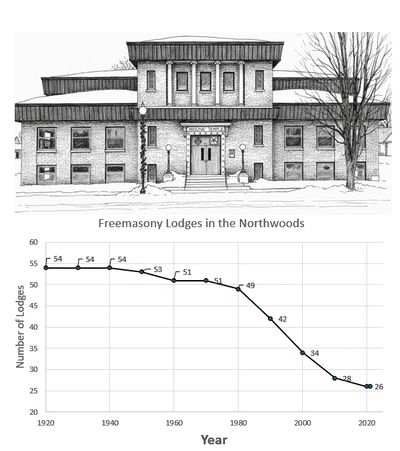
Pictured: Rhinelander's Masonic Temple
Phillips, lidice, czechs, and germans
Flags in the wind
Nestled in a quiet lakeside neighborhood in Phillips, Wisconsin stands a memorial to the victims of one of the most barbaric acts of the Second World War. The Lidice Memorial, located in Sokol park, commemorates the destruction of two Czech villages, Lidice and Lezaky, and the murder of their residents by Nazi authorities in 1942. Please join me as I contemplate the Memorial, its meaning, and its context. It will be a long and wild ride.
BACKGROUND
Today’s Czech Republic is formed from two historical regions, the former Kingdom of Bohemia and the Margarviate of Moravia. The Czech people are western Slavs who trace their lineage to a mythical founder named Cech from whom they derive their name. Both regions developed through the second millennium under heavy German influence first, as a constituent kingdom and province of the Holy Roman Empire, and later, as crownlands of the Habsburgs. To characterize that relationship as wholly oppressive or exploitative would be an anachronistic coloring of history through a twentieth century lens.
The 19th Century saw a tremendous rise in nationalism that was expressed in the imperialism of the United Kingdom and France, the unifications of Germany and Italy, and the beginnings of ethno-nationalist movements like pan-Germanism, pan-Slavism, and Zionism. New countries like Belgium were created, and old nations like Greece, sought and secured their independence from dying empires. It was in that environment that the Czech, as opposed to a Bohemian, or a Moravian, identity was born and prospered.
At the end of World War One the Entente powers dismantled the Austrian and Ottoman empires and created new nations, sometimes, like in the Middle East, out of whole cloth. The amalgamation that became known as Czechoslovakia was one such nation. This process was not always neat and some of the new or revived states like Czechoslovakia and Poland contained sizeable populations of Germans.
German dissatisfaction with the terms of Versailles, particularly its territorial and economic penalties, led to the rise of the Nazi party. Modern day impressions of the Nazis are dominated by their racism and antisemitism, but these qualities were just one part of their platform and were probably not what led to their eventual triumph in and over Weimar democracy. Perhaps more important to German voters was their economic program and nationalism both of which heavily influenced Nazi policy when they arrived in government.
Once in power, Hitler embarked on a foreign policy that sought to right the perceived wrongs of Versailles and his approach was both irredentist and pan-Germanist. Much is now made of his Austrian (as opposed to German) origins and citizenship, but it is important to understand that the concept of an Austria separate from Germany is a modern one. Austria’s existence as a distinct state is a product of the incomplete unification of Germany by the Prussian Hohenzollerns who were unable to include Austria as it was controlled by their rivals, the Habsburgs. Hitler sought to correct that incompletion through his annexation of the Austrian state in early 1938, a move that today is remembered for its clearly rigged ballots but was probably much more popular among Austrians of the time than we, or modern-day Austrians, would like to admit.
After Austria came Czechoslovakia, a state which contained significant ethnic German populations in its border regions, an area known as the Sudetenland. Germans made up nearly a quarter of the Czech population and in mid-1938 Hitler began pressing German claims to the area. These were eventually granted to him in September in an arrangement with the British, French, and Italians known as the Munich Agreement.
In March of the next year the Slovaks, under the direction and with the support of the Germans, declared their independence from the amalgamized state and Czechoslovakia effectively collapsed. German troops occupied those Czech lands not covered in the Munich agreement or included in the new Slovak state. Hitler introduced a German administration and declared the area to be the new “Protectorate of Bohemia and Moravia”. That very name, one grounded in a German-oriented history, as opposed to one including “Czech”, evidenced Hitler’s attitude to what we might call the “Czech question”. Czech independence was not to be tolerated, and a Czech identity was not to be fostered. The events of 1938-1939 saw the Czech people firmly, and involuntarily, placed back into a German dominated Central Europe.
ASSASINATION
Nazi administration of the “Protectorate” prioritized Germanization of the Czech people through an aggressive combination of assimilation and suppression. Hitler leaned heavily on the SS to prosecute this campaign and in September of 1941 appointed Reinhard Heydrich, the infamous architect of the Holocaust, as deputy Reich Protector of Bohemia and Moravia. Heydrich reportedly told his staff that “we will Germanize the Czech vermin” and his rule was so brutal that by early October the Czech government-in-exile began planning his assassination.
On May 27th, 1942, Jozef Gabcik and Jan Kubis ambushed Heydrich in his car at a hair-pin turn outside Prague. The two men had parachuted into Bohemia from the United Kingdom on a mission that they must have known would likely end in their deaths. The firearm Gabcik intended to use jammed and Kubis improvised, throwing a rigged mine at Heydrich’s vehicle which detonated and severely wounded the “Protector”. Gabcik and Kubis went on the run while Heydrich lingered and eventually succumbed to his injuries on June 4th.
On June 18th Gabcik and Kubis, along with a cell of the Czech resistance, were cornered by the SS in a Prague church. A desperate, six-hour firefight ensued and most of the cell, including Gabcik, committed suicide as the Nazis stormed the building. Kubis died at a hospital later that night.
Assassinations are inherently symbolic, Heydrich’s especially so.
During and after the War, central and eastern Europeans came to view French and British appeasement of Hitler, and the Western Allies’ acceptance of the post-war Soviet occupation and forced communization of the area, as a betrayal. In that context, it is inspiring to consider that these two young men and their comrades (they were members of a larger group), who very easily could have chosen to remain in the relative comfort and ease of England, refused to abandon their countrymen. They gave their lives to fight the erasure of their people. It should not be lost in this that Kubis was a Czech and Gabick a Slovak. The location of their last stand is also bathed in symbolism as it was no ordinary church but rather the Cathedral of Saints Cyril and Methodius, the famous apostles to the Slavs who once proselytized in Moravia. The Cathedral still stands today, complete with unrepaired bullet holes from the shoot-out.
ATROCITY
Just as Heydrich’s assassination was symbolic of the Czech resistance to Nazi occupation, the Nazis also sought to make a point in their response. Retribution was to be severe and swift and the small village of Lidice was linked to the assassins through some very poorly interpreted intelligence.
On June 9th German policemen surrounded Lidice and on June 10th they began executing all males over 14 years of age, shooting 173 by the end of the day. Two days later, the women were sent to Ravensbruck concentration camp and the children separated into groups based on their physical characteristics and age. Seven infants were given to orphanages, ten older children were selected for adoption to German families, and the rest, 82 in total, were murdered with gas in a concentration camp in Poland later that summer. Of the 203 women of Lidice, 60 were murdered in concentration camps and 143 survived putting the death toll at 315 though other tallies reach as high as 340. The buildings of the village were then razed and the ruins flattened. Lidice was exterminated.
About two weeks later the SS discovered a radio transmitter belonging to the Czech resistance in the hamlet of Lezaky, about 80 miles from Lidice, and they reapplied their barbaric formula. 33 adults were murdered and of 13 children, 11 were gassed in Poland, and 2 were selected for adoption.
In addition to Lidice and Lezaky, the Nazis murdered 24 members of Kubis’ family in concentration camps. Hitler reportedly wanted to kill 10,000 Czechs as revenge but the plan was scaled back. Accounts vary, with some reporting that more than 10,000 Czechs were arrested and tortured for information on Heydrich’s assassination, and one estimate suggests that nearly 5,000 civilians were murdered in retribution.
REMEMBRANCE AND A CZECH PHILLIPS?
While surely terrible, the massacres at Lidice and Lezaky were by no means unique. They fit into a long pattern of Nazi violence against civilians during, and before, the war. Reprisals against civilians were common in Occupied Europe, Greece in particular saw Lidice-style eradications of small towns. What was even more common were arbitrary roundups and shootings of civilians in atrocities that never received memorable names. Countless numbers died this way in captive Poland, the Balkans, and Russia.
But there are no monuments to say, Guernica or Oradour-sur-Glane, in the Northwoods. So why did the people of Phillips feel so moved by the fates of those two Bohemian towns? What connections did they feel to the victims of this European war?
Every third weekend in June, Phillips hosts its annual Czech-Slovak Festival, colloquially known as “Czech-fest”. Traditional costumes are donned, kolaches are devoured, and a Ms. Czech-Slovak Wisconsin is crowned, or more accurately, sashed. Residents and visitors delight in celebrating the culture and customs of central Europe in what is, purportedly, a very Czech town. That Czech heritage is what we must assume, motivated the erection of the Lidice memorial - but just how Czech is Phillips?
According to City-Data, a website that collects and publishes Census data, of 521 Phillips respondents to ancestry questions only 17 (2.6%) reported Czech, or Czechoslovakian heritage, a number dwarfed by those reporting German (191) and Polish (59) ancestries.
There are some serious issues with these numbers because there is no set criteria for determining someone’s ancestry. Does a person report the nationality of a majority of their ancestors? Of their surname? Of the ancestry that, for whatever reason, they most identify with?
Add to that the fact that most people today are essentially mutts. Most of us of European extraction are descendants of ancestors from several different countries.
Using myself as an example, my last name is German, but my first patrilineal ancestor arrived in the United States in the 1810s and I highly doubt that all of my grandfathers were marrying full blooded Germans from then until now. While that first ancestor was ethnically and culturally German, the region in which he lived at the time (Alsace) was administered by the French and his port of embarkation, Le Havre, was also French, so am I French?
My mother’s side descends from more recent immigrants who are easier to trace, they were Scottish and Swedish. So, if I am to self-report my ancestry what do I say? German? French? Swedish? Scottish? I summarize things by saying German, but I know that isn’t really accurate. I imagine most people are like that.
So let’s throw out those Census numbers, they might be good to get a general feel of things, but we shouldn’t take them as gospel truth. If we can’t use the Census what can we use?
Gregory Boyd, through his Aphrax publishing house, compiles and sells very useful data on initial land patents, claims, and homesteads at the time of early settlement. I own two of his books, Family Maps of Price County, Wisconsin and Family Maps of Taylor County, Wisconsin and I highly recommend them to anyone interested in tracing ancestries or researching local histories. Using the Price County book I identified the surnames of the early settlers of Phillips, they are as follows.
BACON
BAILEY
BARTHOLOMEW
BEEBE
BRIGGS
BROWN
BURNHAM
BURRINGTON
CANNAUGHTY
CHAPMAN
COIN
CONNAUGHTY
CONRADI
CORBETT
CURTIS
DEMAREST
DORR
DRAPPER
EARLY
ENRIGHT
FRADENBURG
FRAYN
GASSMAN
GURNSEY
GURNSEY
HARMON
HEIMARL
HENNESSEY
HEWETT
JACKSON
JOHNSON
KAATZ
KIRKLAND
KNAPP
KONEMANN
KRAIMER
KRAUS
LAIRD
LEHMANN
LOCKS
MANLEY
MANING
MCMULLEN
MISHLER
NORTON
PERRY
PLUNTZ
RAAP
SLYTER
SPAFFORD
STOELTING
STROLL
STOUT
TAINTER
THOMPSON
THORP
TURNER
WATSON
WHITE
WILCKEN
WILSON
YORK
As you can see, most of these names are of British origin, after those come the Germans, but only one of them, Mischler, stands out as potentially Czech. It could also be Polish, or Slovak, but is most likely German. If there weren’t Czechs in early Phillips, then where were they?
From looking at all of the surnames listed in Boyd’s book I identified about 40 that are Slavic, likely Slavic, or potentially Slavic. I am simply not knowledgeable enough to differentiate Czech from Polish, or Slovak surnames, so we’ll be extremely generous and assume that all of them are Czech. They are as follows:
Name // Map Group // Modern Township (approx.)
KOULA // 1 // Lake
KOUL // 1 // Lake
TATRO // 2 // Lake
WARDINSKE // 2 // Lake
ZOESH // 2 // Lake
TIATZ // 3 // Eisenstein
KOULA // 6 // Lake
KOUL // 6 // Lake
KOULA // 7 // Lake-Fifield
SWEZEY // 7 // Lake-Fifield
KOUL // 7 // Lake-Fifield
LUETKE // 9 // Fifield
ROZELL // 9 // Fifield
KUCZENSKI // 11 // Flambeau
MIEVES // 11 // Flambeau
CZISNE // 11 // Flambeau
PURSCHWITZ // 15 // Emery
MINNICK // 17 // Elk
MISHLER // 18 // Phillips
ZAPFE // 20 // Emery
MENTE // 22 // Elk-Harmony
PROCHASKA // 23 // Worchester
TIO // 23 // Worchester
ZIEMIANEK // 23 // Worchester
HORNIK // 24 // Hackett-Emery
HUMMITZSCH // 24 // Hackett-Emery
KOSAKEWITZ // 25 // Knox
KOSEKEWITZ // 25 // Knox
KOSEY // 25 // Knox
NARVA // 25 // Knox
SIMCUSKEY // 27 // Catawba
WISMOLAK // 27 // Catawba
NEDDO // 29 // Prentice
HOUK // 30 // Knox
TUISKI // 30 // Knox
WIK // 30 // Knox
LYCKE // 30 // Knox
MISHLER // 31 // Kennan
LUEDKE // 35 // Hill
NEDDO // 36 // Spirit
ZUHLKE // 35 Spirit
As you can see, they’re spread widely over the County without significant concentration in any one township and certainly not in Phillips.
So now we’ve looked at modern census data and historical settlement data, and haven’t seen many Czechs. It’s quite odd isn’t it? It certainly doesn’t match my experiences with people from Phillips. I’ve personally met people from the area who claim Czech heritage, so what’s going on here? Let’s dig a little deeper to find our Czechs.
Examining the Phillips City Directory reveals quite a few Slavic, probably Polish but potentially Czech, surnames among the City’s officials; Lontcoski, Bogdanovic, Klimowski, Brzeskiewicz. German names dominate; Puhl, Toelle, Heizler, Hauschild, Kosmer, Schoenborn, Heitkemper, then British; McArthur, Clark, and Elliot, and finally we have an odd Swede; Peterson.
We’re making a little progress here, but I’ve saved the best for last.
A very shallow sampling of Price County GIS landowner data for Phillips is where we finally find our Slavs and, potentially our Czechs; Budaj, Polacek, Vasek, Nemec, Kucaba, Staroba etc.
So, it seems that there are Czechs in Phillips after all, just not as many as you would think in a town with a Czech-fest and a memorial to Lidice. They likely came after the initial settlement of the area in the 1870-1890s and probably bought land from the first European residents. Whenever we talk about immigration from non-English speaking countries, we should consider the anglicization of surnames at entry. This was common and may account for some of our missing Czechs.
In this study I can’t help but wonder about the Germans. Phillips may have a Czech American minority that makes them distinctive when compared to neighboring communities, but it appears that German Americans form, at the very least, a plurality in the city. What feelings did they have at the erection of the Lidice Memorial, commemorating an atrocity committed by their European cousins? The text of the plaque at the memorial only mentions the Gestapo, not Germans specifically, and perhaps that was purposefully done.
With so many German Americans in Phillips, why is there no monument to say, Dresden? Well, obviously because America bombed Dresden but there’s more going on than just that.
THE FORGOTTEN DESTRUCTION OF GERMAN AMERICA
“Any man who carries a hyphen around with him carries a dagger that he is ready to plunge into the vitals of this Republic” – Woodrow Wilson, 1919
While Hitler, Heydrich, and the Nazis were beginning their efforts to destroy Czech identity, language, and culture, another country an ocean away was finishing a similar effort against a different ethnic group. I speak, of course, about the United States and its very large ethnic Germany minority.
While not as violent or aggressive as Nazi attempts to Germanize Czechs, the American effort to forcibly melt Germans into the proverbial pot was far more effective and long-lasting. Anti-German sentiment was not unheard of in the 19th century, but the Americanization campaign began in earnest during the First World War. Today, German Americans still form the largest non-English ethnic group among Americans of European descent and are especially prevalent in the Plains and the Midwest, Wisconsin included, but that population is thoroughly Americanized. That, however, was not the case before World War One when German culture flourished in our Country, our region, and our State.
There were small German populations in colonial America at the time of the Revolution, particularly in Pennsylvania. Significant emigration from Germany to America began in the 1840s and spiked in the 1850s with the flight of revolutionaries from the European upheavals of 1848. The flood of Germans reached its all-time peak in 1884 in response to changing patterns of urbanization and rural land ownership. Germans and German Americans made substantial contributions in the Civil War with nearly half a million of them serving in the Union Army, accounting for about a quarter of the entire soldiery. By 1900, the vast majority of the ancestors of modern-day German Americans were here, in the United States, well before World War I and long before the rise of the Nazis.
As I’ve mentioned in other pieces, German settlement in Wisconsin was widespread and impactful. German influences can be felt in our architecture, cuisine, and language and directly seen in our demographics and religious landscape. This is as true in the Northwoods, and Phillips, as it is in the rest of the State. Most German Americans in Wisconsin and elsewhere responded to the outbreak of the Great War with consternation and cynicism. German Socialists in Milwaukee decried it as a crime of capitalism and German Lutherans lamented its arrival as a punishment from God. Speaking broadly, German Americans were not rooting for the Kaiser or the Fatherland they had abandoned. What they wanted, above all else, was peace and American neutrality – they were to be disappointed.
By 1917, the anglophile New England establishment that largely controlled American foreign policy at the time achieved its long-held aim of entering the United States into the War on the side of the Entente. A pro-British press succeeded in galvanizing the public, and more importantly Congress, against the Central Powers with tales of German barbarity. Many of these were invented, such as the bayonetting of Belgian babies, and others were greatly exaggerated or lacked context, like the U-boat campaign, but in the end, it was the Zimmerman telegram, a German foreign policy blunder, that tipped the scales.
It is important here to understand the British modus operandi in European affairs. Ever since the Norman invasion the English, and later British, ruling class has taken an interest in expanding its influence on the Continent. That interest has almost always been frustrated in episodes such as the Austrian imprisonment of King Richard I, the failure of the Hundred Years War, or the inability to effectively aid the Huguenots in the French Wars of Religion. That frustration led to envy and a desire to thwart whatever power was preeminent in Europe at the time, first with the Spanish, then the French, and finally the Germans.
Those efforts by the British state were paralleled in that nation’s Press, so effectively that many of its creations have either been accepted as historical fact or at the very least, entered the popular Zeitgeist. Perhaps the first example can be found in the so-called Black Legend of Spain and if you think of Napoleon as being short and angry, you can thank the British press. That tradition of the British press was transplanted to America and can be seen in depictions of Germans as “Huns” or even apes. It was instrumental in pushing the public toward involvement in the War with a villainized picture of Germans, both in Europe, and in America.
Agitation by the press and opportunistic demagogues created an atmosphere of panic. German Americans faced three types of pressure during this period; legal, external , and internal.
LEGAL: Most notable are the Espionage Act of 1917 and the Sedition Act of 1918 which punished a wide range of constitutionally protected behavior with up to 20 years in prison. Pacifists and socialists were jailed across the country, and four states made it a misdemeanor to even possess a German flag. A German American visiting Florida complained about a change in the weather and was arrested under the Espionage act. Several states banned the use of German in both public and private schools.
EXTERNAL: The best example is provided by the so-called “Knights of Liberty”, a hyper-nationalist society that operated similarly to the Ku Klux Klan. The Knights beat, burned, lynched, and even tarred and feathered, their way through America’s German population. In Texas they publicly flogged a Lutheran Pastor for preaching in German. In nearby Duluth, Minnesota they lynched a Finn, and in Ashland they tarred and feathered two German Americans in a two-week period. They vandalized and even razed Lutheran and Mennonite churches.
Aside from the Knights, another group of note was the “American Protective League”, a group established and directed by the US Department of Justice whose local councils produced a more industrious though thankfully less violent bigotry. People with German last name were banned from joining the Red Cross and found their employers harassed by “concerned” citizens. The Pittsburgh Symphony Orchestra banned the playing of pieces composed by Germans like Beethoven, and others like Cincinnati’s Symphony Orchestra and New York’s Metropolitan Opera Company (the Met) followed suit. Closer to the Northwoods, a machine gun was once emplaced before Milwaukee’s Pabst Theater to prevent the performance of a German play. Groups across America burned German books by the thousand.
Thousands of companies, clubs, churches, buildings, municipalities, and streets had their names changed to remove any hint of their original Germanness. New Berlin, Ohio became North Canton and Milwaukee’s Deutscher Club became the Wisconsin Club. Somehow Phillips’ Germania street managed to survive. The word “Liberty” was very popular, hamburgers became “Liberty steaks” and sauerkraut “Liberty cabbage”, one New England physician even attempted to rechristen German measles as “Liberty Measles”.
Perhaps hardest hit were American newspapers that published in the German language. In 1917 there were 522, more than every other language, excluding English, combined, but by 1920 that number was nearly halved with only 278 remaining in operation. By World War Two the industry had practically gone extinct.
INTERNAL: Aside from the pressures exerted on them by the Federal and state governments or by groups and individuals of Americans of British descent, German Americans applied the prejudices of the day inward on to themselves. In the first month of America’s entry into the War Milwaukee courts processed nearly 200 name changes and this metric only increased as time passed. One petitioner in Pennsylvania captured the feeling nicely by saying that he “has no purpose or reason in changing the spelling of my father’s name, except the desire to relieve my sons of a Teutonic appellation which I believe will arouse hostility and prove an unnecessary burden in their future social, personal, commercial, and professional relations.”
German Americans were both victims, and perpetrators, of Germanophobic violence. Right here in the Northwoods, parishioners of a German Lutheran Church in Peshtigo formed a mob that forced one of their members to buy liberty bonds and kiss an American flag. Perhaps the most famous lynching was that of Robert Prager in Collinsville, Illinois by a mob led by a man named Joe Reigel, himself of German extraction.
Clearly German Americans internalized much of the public’s accusations of disloyalty and competed with one another in committing overt acts of patriotism, whether by buying war bonds, or denouncing other Germans.
----------------------------
It is important to mention the persecution of Mennonite and Hutterite communities. Their pacifism and reclusiveness, combined with their German roots, made them especially ripe targets for bigotry. Their meeting houses were burned down, their men forcibly conscripted despite being conscientious objectors, and some communities even had their livestock stolen and sold, the proceeds being used to purchase Liberty Bonds. Things were so bad that over one thousand Mennonites fled to Canada.
It is also worth noting that the campaign against Germanness coincided with the Red Scare of 1919 and widespread anti-black racial violence across the country. These events are linked, with many Socialists being of German extraction and sympathetic to America’s downtrodden black population. It could be viewed as one single event with many facets.
----------------------------
The German American population that survived into the 1920’s and 1930’s was a thoroughly beaten Americanized one. The period of persecution had robbed them of their culture, language, and history but still, non-interventionism remained popular in the Midwest in the lead up to World War Two. It is best personified by famous aviator Charles Lindbergh, a descendant of Swedish immigrants to Minnesota, and the son of one of only a few Congressmen to oppose America’s entry into World War One. Lindbergh was a spokesman for the America First Committee that advocated for American isolationism and neutrality in the early 1940s and he was even publicly admonished for his views by FDR. Perhaps the Northwoods’ own Richard Bong, a fellow Swede and America’s top fighter ace in World War Two, saved America’s Swedes from the fate suffered by its Germans.
Similarly to Bong, the prominent participation of German Americans in the second war did much to rehabilitate that group’s self-image. America’s military was led at sea by Admiral Chester Nimitz, on land by General Dwight Eisenhower, and in the air by General Carl Spaatz, all men of German descent. Maybe it took Germans to beat Germans.
It is said that the Spanish American War provided a salve that helped heal the rift between the former states of the Confederacy and the rest of America. During the German invasion of the Soviet Union, Soviet authorities relaxed their persecution of the Orthodox church in the hope of using it to motivate the peasantry, both as workers and soldiers. A similar process happened in America, as it was the German American Midwest, more than any other region, that grew the food, and built the rifles, tanks, and bombs, that beat the Axis.
Despite the healing of the last century or so, the scars of the persecution of German Americans can still be seen. The group exists submerged and forgotten beneath our country’s cultural fabric and when it does emerge, it appears as a flanderized characterization of Bavarian drinking culture. When you go to a bookstore, for example, the Barnes & Noble in Wausau, you can take your pick from a variety of books on British or French history, but the small German section is all swastikas. The history of one of Europe’s largest groups is defined by a 12-year period. German history, like German heritage, remains something to be ashamed of, not celebrated. In a similar vein Phillips, a town of mostly German Americans, has a Czech fest and a Lidice memorial.
I write none of this as a criticism of Phillips’ Czech community or its traditions. In fact, my personal feelings toward them, their festival, and the Lidice memorial, are very positive. I find them inspiring and worthy of emulation. Charlotte ‘Toni’ Brendel, a Phillips resident and organizer of Czech-fest, has written many books on Czech topics and is worthy of praise and admiration. If I could have my way, every community in the Northwoods could have their own Toni, and we would celebrate our shared heritage, whether it be Czech, German, Swedish, Norwegian, Finnish, Polish or Hungarian with the same amount of zeal she brings to Phillips.
All of that said, we don’t have a thousand Brendels and we can’t expect them to arise anytime soon. We simply cannot rely on others to propagate our history for us. The University of Wisconsin’s history department made famous by Fredrick Jackson Turner and his Frontier Thesis might be nationally renowned, but it is locally useless. The Department and the larger University, long ago abandoned the “Wisconsin Idea”. Similarly, Wisconsin’s Public Broadcasting enterprises, both on television and in radio, don’t seem interested in providing quality programing about anything other than the experiences of LGBT, African American, and Native Americans in the State. This chasm between the Northwoods and the rest of the State will only grow as those institutions delve deeper into their bourgeois, luxury politics, and urbanite navel-gazing.
If you want something done right, it’s best to do it yourself, so go to Czech-fest, visit the Lidice Memorial and celebrate your own family’s history lest, like the persecution of German Americans in this country, it be forgotten forever.
I referred to the following books in writing this piece and recommend them to interested readers;
Germans in Wisconsin, by Richard Zeitlin
Bonds of Loyalty, German Americans and World War One, by Frederick Luebke
Burning Beethoven: the Eradication of German Culture in the United States during World War I, by Erik Kirschbaum
