I. Preface
Beginnings
My interest in churches and the history and human geography of religion has its roots, strangely enough, in the American country western music, television, and movies of the early and mid Twentieth Century.
As an adolescent I spent a great deal of my time with my Grandfather, a native of Rice Lake and a retired National Park Service Ranger. I was fed a steady diet of Gene Autry, Gunsmoke, and Bonanza and I soaked it all up like a sponge.
Later, when I joined the United States Army, I was asked to list my preferences of duty stations and I placed Fort Riley, Kansas at the very top. I sought to escape the heat of the Deep South, where the Army has many of its posts, and the mountains of Carson and snows of Drum didn't appeal to me. I figured Riley was in the Midwest so I'd be closer to family, and it's in a region that interests me, or at least did when I was younger.
My branch manager was more than happy to oblige as Riley is not a popular choice. Perhaps the only posting more likely to result in an assignment based on preference would be Korea, and very, very few people request Korea, so off to Kansas I went.
I was not prepared for what I would encounter.
Riley is nestled in the Flint Hills of Kansas, a region in the eastern third of the state dominated by rolling hills, cattle pasture, and very few trees. It isn't quite what one imagines when picturing Kansas as it isn't flat and its rocky soil limits agriculture; the great fields of grain, sunflowers, and windmills are farther west. Perhaps the most striking feature of the area is its winds. If you visit, you will find it an ever-present companion. It pushes on you as you walk, so strongly that it occasionally tips trucks on highways, and its constant howl nearly drove me mad before I acclimated. The sound of the wind roaring against the walls of my home eventually became a bit of a sleeping aid, and when it did occasionally die down it was very off-putting. Kansas without wind feels disturbingly eerie.
Riley is also quite remote. Manhattan, home to Kansas State University, is about 15 minutes from post and is roughly the size of Wausau but it lacks the adjoining and sizeable communities Wausau has in its metropolitan area. It's just Manhattan out there by itself. Aside from Manhattan, there's the smaller and much grungier army town of Junction City but after that the pickings are slim. The nearest city of appreciable size is Topeka, about 60 miles away, and the closest city with a well serviced airport is Kansas City at roughly 130 miles. In that way it's similar to the Northwoods but is less densely populated, and that's saying something considering the relative sparsity of the population of northern Wisconsin. Here you pass through a town every ten or so miles when traveling on Highways 8 or 13 but Kansas isn't like that, it's much more spread out, more desolate.
That desolation, combined with the demands of military life, its workload, and the separation from friends and family, made my adjustment to Kansas difficult, but I found a way to cope. On the weekends I'd jump in my Jeep and drive. I wanted to drive until the road ended but I tried to stay within the mileage bounds dictated by the Army. There was a range that Soldiers were not to exceed without a pass or leave, and I tried to abide by it, but I will admit that on at least one occasion my wanderings almost had me stumble in to Nebraska.
I wanted to see the sights of Kansas and learn its history. In Abilene I visited the Eisenhower Presidential Library and saw the town's less laudable but still famous Greyhound tracks. I toured Council Grove, a town absolutely littered with national historic sites, the most memorable being the still extant ruts made by wagons that once traveled the Santa Fe trail. Closer to Riley, I visited the site of the atomic cannon which overlooks the Post. A relic of the early Cold war, it is one of seven surviving M65 towed howitzers designed to fire nuclear shells. I enjoyed all of it but I saved the best for last and toward the end of my assignment I put in a pass to travel to Dodge City.
I couldn't wait to tell my Grandpa about walking in the town Minnesota actor James Arness made famous in Gunsmoke. Only a small segment of the old western town still exists but that bit was amazing and truly lived up to my expectations. When recounting the visit to Gramps I felt it would be better if I left out the part about how you can smell the town, and its slaughter houses, from miles away before you arrive.
Yep, I feel I did Kansas right.
But in those little Saturday sojourns a tiny seed was planted in my mind. In those small Kansas towns, the ones I'd pass through and in the ones in which I'd stop, I was constantly struck by their historic churches. In every place where people collected, these pioneers and settlers of the great American frontier, surely pressed by the needs of farm and home, took a not inconsiderable amount of time and put in significant effort to erect these buildings that were the focal points of their communities. Each one was unique and a product of love and great care. They stand as manifest expressions of who their builders and congregants were, what they believed, and what they hoped for the future.
Most of the churches about which I'm writing are still active, I don't mean to speak as if they're dead, but I did come to view each as an individual and special specimen. I thought that if I had all the time and energy in the world, I might like to one day tour each one, learn its history, photograph and document it, and perhaps one day record them all in a book.
The Army, as it's wont to do, later moved me around and my Kansas chapter closed but my interest in churches only grew. On returning to the Northwoods I came to view our churches from some of that same perspective I acquired in Kansas, and I've endeavored to learn more about them.
In this series I will share some of the insights I've gained about them, their histories and their current health. I hope you enjoy it.
I know I've written far too much here and that this isn't The Atlantic. Oh how I hate the obnoxious verbosity of The Atlantic. I'll try to be more succinct going forward.
[Photo credit: Public Domain, Farm Security Administration or Office of War Information, United States Government]

A carpenter gothic church outside Junction City, KS
II. Introduction
Through the Eyes of Birds
Over the last few years, I’ve catalogued over 1,000 religious groups, churches, and places of worship across the 22 counties of the Northwoods. My listing is not comprehensive, I lack the tenacity for that, but it does provide a solid base from which to explore the religious landscape of the region. In the process of gathering that information I’ve gleaned a few interesting tidbits of knowledge I’d like to share throughout this series. I intend to write short articles about each denomination but would like this to serve as both an introduction and an exploration of a few oddities and firsts.
The Long Reach of the Past
The churches of the Northwoods reflect the ancestries and patterns of immigration of its founders and residents. Like the rest of Wisconsin, Lutherans and Catholics are the most prominent, with 293 and 176 churches respectively. This is a product of large-scale immigration from Scandinavia and the German and Austrian empires that occurred in the 19th Century.
Just behind the Lutherans and Catholics are the old Baptist churches (~85), which are also a product of the Scandinavians, particularly the Swedes. To the unfamiliar this may seem strange, most people probably don’t think of Swedes as being Baptists, but as the State Church of Sweden was Lutheran, sizeable populations of Baptist Swedes fled what they felt were unfair taxation schemes and restrictions and established new churches, and homes, in Northern Wisconsin.
For the purposes of this series, we’ll call the Catholics, Lutherans, and Swedish Baptists the Big Three.
Sometimes, what isn’t present can be just as telling as what is, and, as I said in What Is the Northwoods, the Northwoods lacks some of the Yankee New Englander (YNE) influences found in southern Wisconsin. Anglicans or Episcopalians have just 19 churches in the Northwoods compared to nearly 100 (97) found in the rest of the State. Almost every single one is in a city of substantial size with virtually no countryside churches. Like the Anglicans, Methodists also have an English origin, though they’re less confidently correlated to YNEs, and are also poorly represented with just 63 UMC churches compared to the 303 in the rest of Wisconsin. Presbyterians are a similar story.
The Newcomers
Over the last half century America, and the Northwoods, has seen an explosion in the growth of Evangelical, and Pentecostal Churches. They constitute the fastest growing segment of American Christianity and are aggressively “planting” churches across the country. I catalogued over 100 of these churches across the Northwoods and nearly all of them are younger than 50 years old. They can be hard to pin down as many do not explicitly identify as being Evangelical, or Pentecostal, and instead frequently claim to be “non-denominational.”
This may be controversial to say but after researching many of them, I can comfortably say that their commonalities do represent a distinct and predictable type of faith, that I would consider, for practical purposes, to be a denomination. They would of course dispute that and argue that they lack the dogma, unity, and hierarchal organization of say, the Catholics, or Lutherans, but my assertion is for working purposes only. I’m not interested in debating semantics.
I would also say, and this too would be controversial, that they are essentially Baptists. Much of their philosophy is the same, and many of their church leaders are the products of Baptist, or Baptist connected, seminaries and bible colleges. I’ll explore this in greater detail later.
Non-Denominationalists, Evangelicals and Pentecostals aside, there’s also been a sprouting of non-Christian groups. It’s much smaller than the ND/E/Ps but still noteworthy. They’ll get their own article as well.
Firsts and Notables
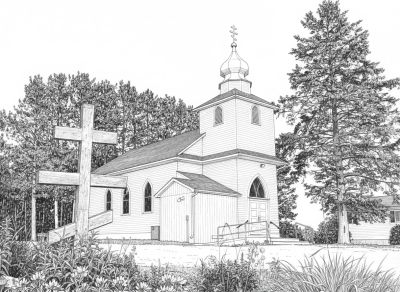
The Northwoods will never be accused of being ahead of the times, but when it comes to churches it does have a few firsts. The earliest and now oldest Orthodox church in Wisconsin is in Gilman and we have perhaps, a higher density of Orthodox Christians, as a ratio to the population, than the rest of the State. This article’s image is of an Orthodox church in Lublin.
Strangely enough, the first Christian Scientist, purpose-built church in the world is in the Northwoods. It’s in Oconto and its builders didn’t realize it was the first until some time later. It even predates the group’s mother church building in Boston. If you can’t remember who they are, they’re the group, that, among other things, commonly eschews medical care.
The Northwoods also has significant contingents of Mormons, Jehovah’s Witnesses, and Anabaptists (Mennonites and Amish) and even hosts three Old Catholic churches (Catholics who reject Vatican I, take that Sedevacantists).
We even have a cult or two.
That concludes a very brief overview of faith in the Northwoods. It had to be done so that we might consider this series properly inaugurated. I hope you enjoy the journey.
III. LUTHERANISM
A Mighty Fortress
Lutherans constitute the largest religious group in the Northwoods with nearly three hundred churches spread across eight different sub-denominations of Lutheranism. The largest are the Lutheran Church of the Missouri Synod, the Evangelical Lutheran Church in America and the Wisconsin Evangelical Lutheran Synod. This diversity reflects patterns of European immigration to Wisconsin and the history of the organization of Lutheranism in the United States.
MARTIN LUTHER AND THE ORIGINS OF LUTHERANISM
Lutheranism is, of course, named for Martin Luther, a 16th Century Saxon friar known for initiating the Protestant Reformation.
Luther objected to the Catholic Church’s sale of indulgences, a practice by which a sinner could make a donation to the Church in exchange for a reduction of time spent in penance. This was often misunderstood to mean a reduction of time spent in purgatory, and Luther was especially perturbed by a particular salesman of indulgences, Johann Tetzel, who he accused of saying that “As soon as money in the coffer rings, the soul from purgatory's fire springs.”
Luther collected his thoughts on indulgences in what is now known as his Ninety-five Theses, a collection of proposals he hoped would be discussed by other clergy and scholars of his day. He sent copies to his Bishop and Archbishop and probably did not intend to begin down a road of eventual schism.
To understand why Luther’s objection to indulgences led to an eventual split in the Church one must view him from a more distant perspective and consider his place within the larger religious history of the Holy Roman Empire.
It is often jokingly said that the Empire was neither Holy, nor Roman, nor an empire but this isn’t entirely true.
Charlamagne, its first Emperor, was crowned by the Pope and charged with the protection of the Catholic Church, headquartered in Rome. Charlamagne's domain was intended to be the successor of the Western Roman Empire that had collapsed three centuries earlier. Establishing the Empire was important for the Pope for reasons of prestige, as the Patriarch of Constantinople, the capital of the still extant Eastern Roman Empire, could potentially outmatch him in influence. Forty-four Emperors after Charlamagne would go on to be crowned by the Pope and the two offices shared authority, with the Pope in charge of spiritual affairs and the Emperor tasked with matters temporal. In this way it was not unlike the modern Kingdom of Saudi Arabia where the House of Saud derives its political authority from the leading religious family, the Al ash-Sheikh, who in turn obtain their religious authority from the ruling Saudis. In these ways it was both Holy, and Roman.
Charlamagne’s empire was eventually split between his grandsons into three kingdoms that became France, Burgundy, and Germany with the German kingdom constituting the bulk of the Empire. The Empire also included, at different times, the kingdoms of Italy, Burgundy, and Bohemia, and it covered a territory that today includes the Netherlands, Switzerland, and parts of Poland and France. In the sense that it was a collection of states and peoples held together by a single authority, it certainly was an empire.
The sharing of power between the Church and the ruling nobility of the Empire was not always harmonious. In the eleventh and twelfth centuries there was significant friction between the two groups in a conflict known as the Investiture Controversy. The Controversy revolved around the selection and supervision of bishops, with Emperors and political authorities disputing the Pope’s claimed primacy in the process.
While their rulers found reasons to challenge the Church’s religious authority, the common people of the Empire developed their own animosity toward what they perceived to be the excesses of the Church and its clergy. Perhaps the best personification of this animosity was Jan Hus, a Bohemian priest and critic of the Church who, among other things, called for worship in the local language instead of Latin, and opposed growing corruption among the clergy. Hus also argued for the preeminence of the Bible over Church decrees and criticized indulgences, two ideas which would be further developed by Luther a century later. Hus captured the feelings of many of his countrymen and his execution by the Church in 1415 led to a series of conflicts known as the Hussite Wars that devastated Bohemia.
The final piece of context vital for understanding the success of Luther and the development of Lutheranism was the ~1440 invention of the moveable-type printing press by Johannes Gutenberg in another part of the Empire, Mainz. Gutenberg’s press made printing much more efficient and productive, leading to an explosion in the availability of reading material and a corresponding rise in literacy. Because of Gutenberg, new and interesting ideas could travel faster and be exposed to far more people than ever before.
In America, perhaps because of our roots in English colonialism or maybe just because we speak English, the Reformation is often discussed in terms of events in England and the actions of King Henry VIII. I know that I was taught from this Anglo-centric perspective in my public-school education, and I find it to be a great disservice. While the Reformation certainly impacted France and England, they were just side-shows compared to the main event that was largely an Imperial one. Imperial figures like Erasmus, a 15th century Dutch philosopher who is said to have “laid the egg that Luther hatched”, and characters who moved to the Empire like Geneva based post-Luther reformer John Calvin, should dominate histories of the period.
It was in this Imperial environment that Luther first surfaced and in this milieu that his ideas flourished into a distinct school of Christianity. The arrival of Martin Luther was very much like a baseball player matching a swing to his bat’s sweet spot, in that his complaints about indulgences and his later reformatory ideas arrived on the scene at the perfect moment. Both the common-people and the political authorities of his time were discontented with the Church, and the printing press allowed Luther, a prolific and convincing writer, to capitalize on those feelings.
The Church’s condemnation of Luther, and Luther’s refusal to back-down, led to schism and the evolution of his philosophy into modern day Lutheranism. Rulers, especially in northern Germany but also in Scandinavia, were quick to adopt Luther’s ideas and enjoy the greater authority it granted them as they no longer needed to answer to the Roman Church. At the same time, commoners and clergy flocked to his more accessible and populist interpretation of the Faith. The ensuing division between Lutherans and Catholics in the Empire eventually led to the Thirty-Years War, the Peace of Westphalia, and the seeds of the religious pluralism and toleration we enjoy today.
By 1800, large parts of Central and Northern Germany, along with Sweden, Norway, and Finland, had Lutheran State Churches and it is from these areas that Northern Wisconsin drew many of its 19th century immigrants. Those settlers brought their Lutheranism to the Northwoods and established the hundreds of Lutheran churches we have today.
WISCONSIN
Lutheran settlers of the Northwoods first organized their churches according to language and national origin, examples include the Swedish Evangelical Lutheran Church in Shell Lake and the Jolster Norwegian Church in Hawkins. Early churches were humble buildings built in a rudimentary carpenter gothic style that were frequently replaced with sturdier structures when congregations grew larger and more affluent. The Estonian Evangelical Martin Luther Church outside Gleason still exists today and is a perfect example of the typical church of the era. Churches associated with one another through what were largely national synods such as the Swedish Evangelical Lutheran Augustana Synod in America and the Norwegian Augustana Synod.
As time passed these Synods began to coalesce into the larger synods we know today with the Evangelical Lutheran Church in America (ELCA) being composed of mostly Scandinavian churches and the Lutheran Church Missouri Synod (LCMS) and Wisconsin Evangelical Lutheran Synod (WELS) representing mostly German churches. As immigrants and their children assimilated, they often changed the names of their churches, with Hawkins’ Norwegian Church becoming “Bethel Lutheran Church” and Cumberland’s Swedish Church becoming “Augustana Church”. The language of worship changed as well with English replacing Swedish, Norwegian, and German. A good example of this change in language is the First English Lutheran Church in Wausau, which was named not for Lutheran settlers from England but rather for being the first Lutheran church in the area to worship in English.
The big three synods of today, the ELCA, LCMS, and WELS, have also begun to diverge in terms of theology and politics. The ELCA represents a much more progressive interpretation of Lutheranism that includes ordination of women, affirmation of homosexuality, and communion with other Protestant but not Lutheran churches such as the Presbyterian Church, the United Methodist Church, and the Episcopal Church. Both the LCMS and WELS have stuck to a more traditional, and some would argue more authentically Lutheran, form of faith that rejects many of the ELCA’s innovations. Between them lie much smaller, and more moderate groups such as the Lutheran Congregations in Mission for Christ, the American Association of Lutheran Churches, and the Association of Free Lutheran Congregations.
Many communities in the Northwoods have multiple Lutheran churches belonging to the different synods and all of the groups are facing declines in membership, attendance, and clergy. This development is not confined to Lutheranism and reflects a larger national trend of declining religiosity. What is interesting is how each group approaches the challenges of the future.
THE EVANGELICAL LUTHERAN CHURCH IN AMERICA – ELCA
107 Lutheran churches in the Northwoods are affiliated with the Chicago based ELCA with Barron, Marathon, and Chippewa counties having the most at 16, 15, and 10 respectively. Ashland, Langlade, Vilas, and Rusk counties have the fewest with each hosting fewer than five.
The churches are spread across three suborganizations of the Church in what the ELCA terms as “synods”, these are the Northwest Synod of Wisconsin, the East Central Synod of Wisconsin, and the Northern Great Lakes Area Synod based in Michigan’s Upper Peninsula. Wisconsin has a relatively high number of these sub-synods at five with only Pennsylvania and Minnesota having more which would seem to indicate a relatively high density of congregants in the State compared to the rest of the Country.
The ELCA’s 2025 report of Congregations Consolidated Disbanded, Merged, Removed, or Withdrawn paints a picture of a Church in national retreat with 86 local churches leaving the group in just one calendar year. Only three churches were reported to have merged so the lion’s share of these departures represent real losses to the ELCA. Recent closures in Northern Wisconsin include Immanuel Lutheran Church of Wausau and Trinity Lutheran Church of Rice Lake, both of which closed in 2025 but for whatever reason were not included in the ELCA’s 2025 report. Their omissions could indicate that the report is not comprehensive and that the ELCA is losing churches at a higher rate than they are willing to admit. Immanuel of Wausau merged with nearby St. John Evangelical Lutheran Church but closed their primary building, while Trinity disbanded and sold their building to a start-up evangelical church known as the “Trinity Fellowship.”
I was unable to identify named clergy at 28 of the churches but I did identify 39 churches with female pastors, reverends, ministers or vicars compared to just 33 with male leadership. The remaining churches are led by teams of mixed genders. ELCA strategies in addressing clergy shortages focus on clustering. At least eleven clergy members lead worship at two churches and five lead worship at three churches. When a vacancy can’t be addressed through clustering, specially recognized lay members known as Synod Authorized Ministers step in to fill the gap. The average attendance at worship services in ELCA churches is ~39 and the median attendance is 47.
In an interesting arrangement, ELCA congregations will share building space, and even clergy with other protestant churches and the Church has established full communion with the American Episcopal Church, the Presbyterian Church (USA), the Reformed Church in America, the United Church of Christ, and the United Methodist Church. I imagine this agreement would be enough to cause Henry VIII, John Calvin, and Martin Luther to turn in their graves simultaneously, but it reflects an ecumenical posture born from a shortage of clergy and a convergence in doctrine. This cooperation is especially interesting in the context of German Lutheran history but as the ELCA is largely Scandinavian in origin, that isn’t immediately relevant – I’ll touch on the subject later.
THE LUTHERAN CHURCH – MISSOURI SYNOD - LCMS
82 Lutheran Churches in the Northwoods are members of the Lutheran Church – Missouri Synod, with Shawano, Clark and Oconto having the most and Iron, Chippewa, Marinette, and Sawyer counties hosting the fewest. The LCMS is organized by regions and then districts with all of the Northwoods’ member churches lying within the Northern Wisconsin District of the Great Lakes Region.
The LCMS does not publish a readily accessible summary of church growth and decline but it does make its attendance numbers public and tries to collect some basic historical data. At least four of its churches predate 1880, those being Faith Lutheran Church of Merrill (1871), Saint James Lutheran Church of Shawano (1873), Saint John Lutheran Church of Merrill (1876), and Saint John Lutheran Church of Wausau (1878). The average attendance at worship services in LCMS churches is ~82 and the median attendance is ~68.
Clustering is less common than in the ELCA with only five clergymen serving more than one church and no pastors officiating at more than two. In keeping with the Synod’s policy on ordination, of the sixty-two pastors and reverends I identified, all were male, and German surnames predominated, reflecting the group’s history.
The Synod’s formation by Lutheran immigrants from Saxony has influenced its ecumenical relations when compared to the ELCA. In 1817, Prussian King Fredrick William III forcibly consolidated the Calvinist and Lutheran churches in his Kingdom into a single Protestant Church, the Evangelical State Church of Prussia. This union was fractious and unpopular with many adherents of both denominations, and it eventually triggered emigration of Lutheran dissidents who went on to form the LCMS in America. That history, and doctrinal differences, help explain the reluctance of the LCMS to establish the broad ecumenical relations of the ELCA, who, as Scandinavians, lack that experience of coerced communion.
THE WISCONSIN EVANGELICAL LUTHERAN SYNOD – WELS
To the theological right of the LCMS lies the Wisconsin Evangelical Lutheran Synod which counts 68 churches across the Northwoods as members. Marathon County has by far the most at more than 10, while Ashland, Rusk, Sawyer, and Washburn counties have the fewest.
Like the LCMS, the WELS has its origins in German Lutheran immigration, having been formed by Lutherans in Milwaukee. It is the only Lutheran group to be formally incorporated by an act of the Wisconsin legislature, and is now headquartered in Waukesha. Despite the name, the Synod includes many churches outside of Wisconsin and is organized into twelve districts, three of which cover the Northwoods; the Western Wisconsin District, Northern Wisconsin District, and the Minnesota District.
In contrast to shrinking denominations like the ELCA, WELS is aggressively growing and has a goal of planting 100 new churches across the country by 2033, with the newest congregation in the Northwoods being in Kronenwetter. This expansion is sought in spite of shortages in clergy as clustering is seen in pattens similar to the ELCA. Eighteen of the 68 WELS churches share clergy with another church and at least two pastors officiate at three churches. According to their most recently available data, the average attendance at Northwoods WELS churches is 78, and the median is 52. As in the LCMS, all clergy were male, and the Church’s ecumenical relations are very limited.
THE OTHERS
Five other Lutheran Churches/Associations have congregations in the Northwoods but have far fewer members than the Big Three. In order of size they are the Lutheran Congregations in Mission for Christ (LCMC) with 16, the North American Lutheran Church (NALC) with 7, the American Association of Lutheran Churches (AALC) and Association of Free Lutheran Congregations (AFLC) both with 2, and the Saint Henry Lutheran Mission with 1.
The LCMC and NALC are both splinter groups of the ELCA, having formed in 2001 and 2010 respectively. Together they claim a moderate doctrinal position in between the ELCA and the LCMS. The AFLC and AALC are both older and occupy more conservative positions. The Saint Henry Lutheran Mission appears to be a small, localized effort.

First Lutheran Church, ELCA
Ogema, WI